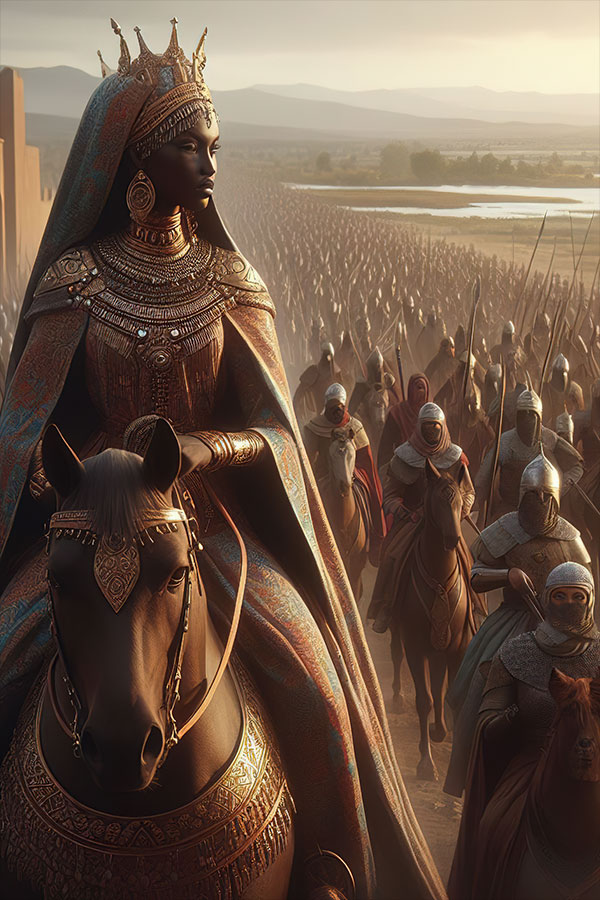
A skilled warrior, Queen Amina (1533-1610), our last great woman, ruled the largest city-state, Zazzau (now Zaria), in the Hausa Kingdom (also Hausaland). Her parents were King Nikatau of Zazzau and Queen Bakwa Turunku, and her grandparents were King Sarkin of Nohir and Marka (grandmother). She was the eldest of her siblings, Karama (brother) and Zaria (sister). The family was independently wealthy, her parents trading in kola nuts, salt, imported metals, horses, and cloth. From historical accounts, her parents and grandparents, for that matter, took an active role in shaping her into the woman and the warrior she came to be. Widely known for her skills in battle, Queen Amina accomplished so much more for the people of Zazzau.
Her life began in a palace, which is now in the Kaduna State in Nigeria. One can only imagine the physics available to African engineers at the time, but from historical accounts, it was majestic, enough to house her family and the many slaves they owned. Still, the palace, now called the Emir of Zazzau Palace, was constructed using mud, which characterized Hausa architecture at the time. The palace’s exterior walls contained motifs and patterns that reflected the Zazzauan culture of the time. Unlike many great buildings that are some distance from the people, the palace was in a residential area with very high walls and elaborately crafted gates. One might argue, by living close to the people, the monarchs sought to remain in touch with their subjects. The palace was built just before Queen Amina sat on the throne, its construction sometime in the 15th century.